Storing Dahlias
Dahlia tubers require careful winter storage in colder climates like USDA Zone 6a in West Michigan, where freezing ground temperatures make inground overwintering impossible.
Gardeners use a variety of methods to keep tubers dormant, prevent rot from excess moisture, and avoid shriveling from too-dry conditions.
The goals:
consistent cool temperatures (ideally 40-50°F, with many aiming for 40-45°F)
moderate to high humidity (around 75-90%, often 80-85% in enclosed setups)
good airflow
no direct wetness or freezing.
Common approaches include:
Dry storage — Shake off excess dirt, dry clumps briefly, and store whole or divided clumps in crates or boxes in a cool basement or garage, relying on ambient humidity—no added medium needed for simplicity.
Absorbent mediums — Pack dried tubers in vermiculite, peat moss, wood shavings (like pine or cedar), or similar in bins, bags, or crates to maintain humidity while keeping surfaces dry and preventing mold.
Minimal-wrap methods — Wrap individual tubers or small bundles in plastic wrap (like Saran Wrap) or newspaper for space efficiency and moisture retention, then box them, no medium required.
Other variations — Use slightly moistened peat in containers, store in coolers or root cellars, or keep clumps with some dirt intact in crates for natural buffering.
These methods all prioritize the three essentials: no freezing, no wet tubers, and sufficient surrounding humidity to prevent dehydration. You need to find what works best for your environment and setup.
The most common question I get is: "Where can I store them to keep them from freezing, dry, and dormant?" Years ago, before I became a full-time dahlia farmer, I used a wine refrigerator with the plastic-wrap method, it worked well for smaller quantities and could still be a great option for home growers. But when I ran out of space and needed to store thousands of tubers, I had to scale up. Here's how I store about 5,000 tubers this winter.
My Setup in Zone 6a West Michigan
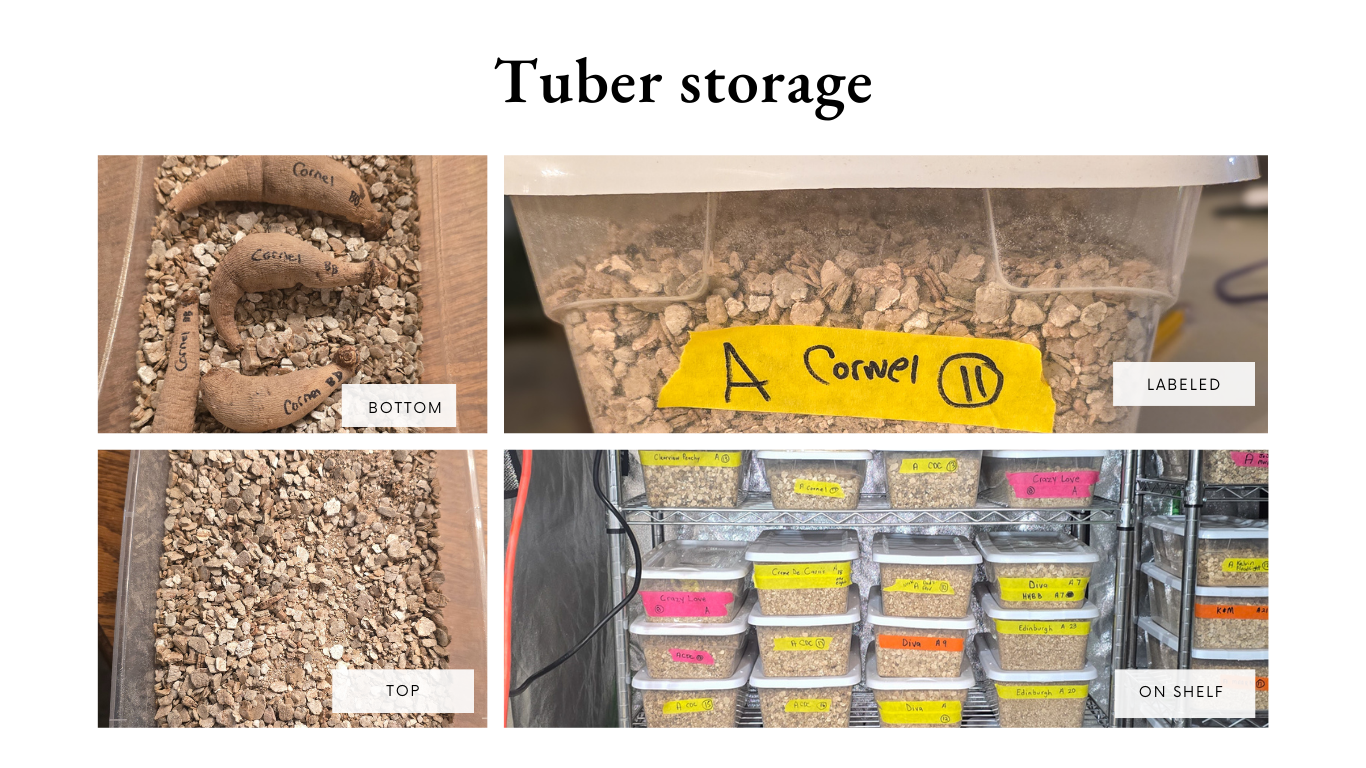
I use the absorbent-medium method: packing dried tubers in plastic boxes with vermiculite for excellent moisture balance.
I rely on grow tents equipped with automatic heaters to maintain a steady 40-42°F—perfect for avoiding freezes and premature sprouting through our variable winters.
Packing Dahlia Tubers for Winter Storage
I start with dug, divided, washed, air-dried, cinnamon-dipped (as a natural antifungal), and labeled tubers. (Each of these prep steps could be its own blog post!) Once ready, here are my packing steps:
Select containers — Use clear plastic shoe boxes (stackable with secure lids) from Walmart, Dollar store etc. They're affordable, transparent for easy checking, and the perfect size for manageable batches.
Add base layer — Fill the bottom with a thin layer of coarse vermiculite (chunky grade promotes airflow and moisture balance). Nestle the labeled tubers in, spacing them so they're not touching (helps prevent rot spread).
Build layers — Cover the first layer with more vermiculite. If space allows (I usually fit two layers total), add a second layer of tubers, then cover completely with vermiculite. Leave about an inch of headspace at the top for air movement.
Add ventilation — Drill 4–6 small holes around the outer edge of the lid (so holes stay clear when boxes are stacked) to promote gentle airflow without excess drying.
Label the box — Use colored painter's tape (light colors like white, yellow, or light blue for easy reading) on the front.
Note variety name(s) and count. Painter's tape sticks well but removes cleanly—no residue—making sanitizing for reuse simple.
Setup for the Long Winter
Once packed, the boxes go into my attached unheated garage (now my dahlia workshop—no cars anymore!).
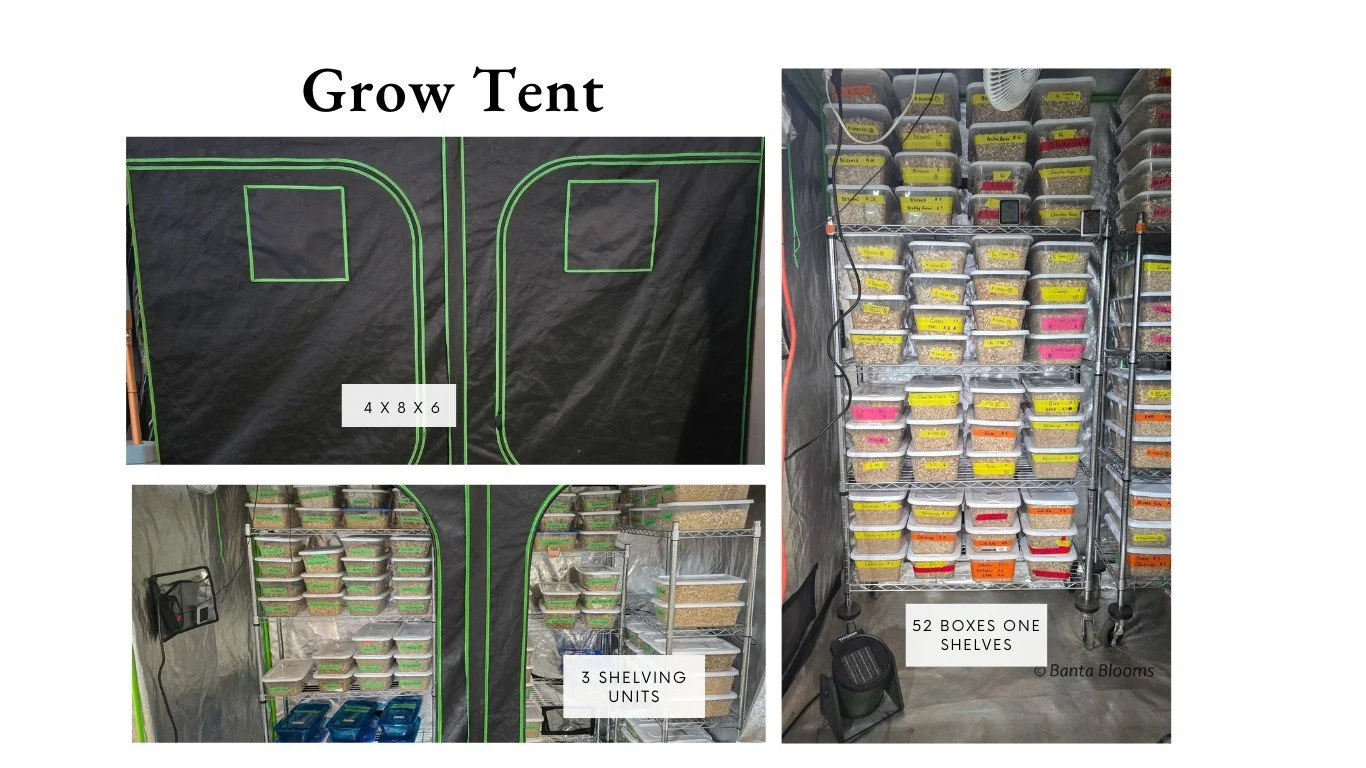
I use two 4x8x6" VIVOSUN grow tents as enclosed "storage vaults." While designed for growing, their light-proof, insulated structure maintains darkness, stable temperature, and humidity with minimal tweaks.
Key elements:
Grow tents — Two 4x8x6" VIVOSUN models (or similar; check Facebook Marketplace for used ones—hobbyists sell them affordably).
Auto heater — Small portable greenhouse electric heater (1500W) with adjustable digital thermostat. It kicks on only if temps drop below 40°F, holding 40-42°F safely. I chose one with auto-shutoff for fire safety, placed away from boxes/shelves with good airflow.
Thermometer/hygrometer — Govee Wi-Fi/Bluetooth models for remote monitoring and alerts. I sleep better knowing I can check conditions from bed!
Fan — Small circulation fan to keep air moving in the airtight tent and prevent stagnation.
Humidity boost — A container of water inside helps maintain higher humidity (experts recommend 80-85% ideal; I don't stress it much in my setup, but it helps).
Shelving — Adjustable chrome heavy-duty metal wire units (e.g., 36"L x 14"W x 57"H on wheels). Open-grid design ensures unrestricted airflow around boxes—no rust, and I fit about 52 boxes per unit.
Grand total for a basic one-tent setup (tent, shelving unit, heater, hygrometer, initial vermiculite, and 50–75 boxes): Roughly $500–$700 upfront (lower end with good deals). Most components are one-time purchases that last for years, vermiculite is the primary recurring cost (~$100–$200/year if refreshing). This keeps everything organized, mobile, and well-ventilated while protecting hundreds of tubers through cold Michigan winters, great value for the protection it provides!
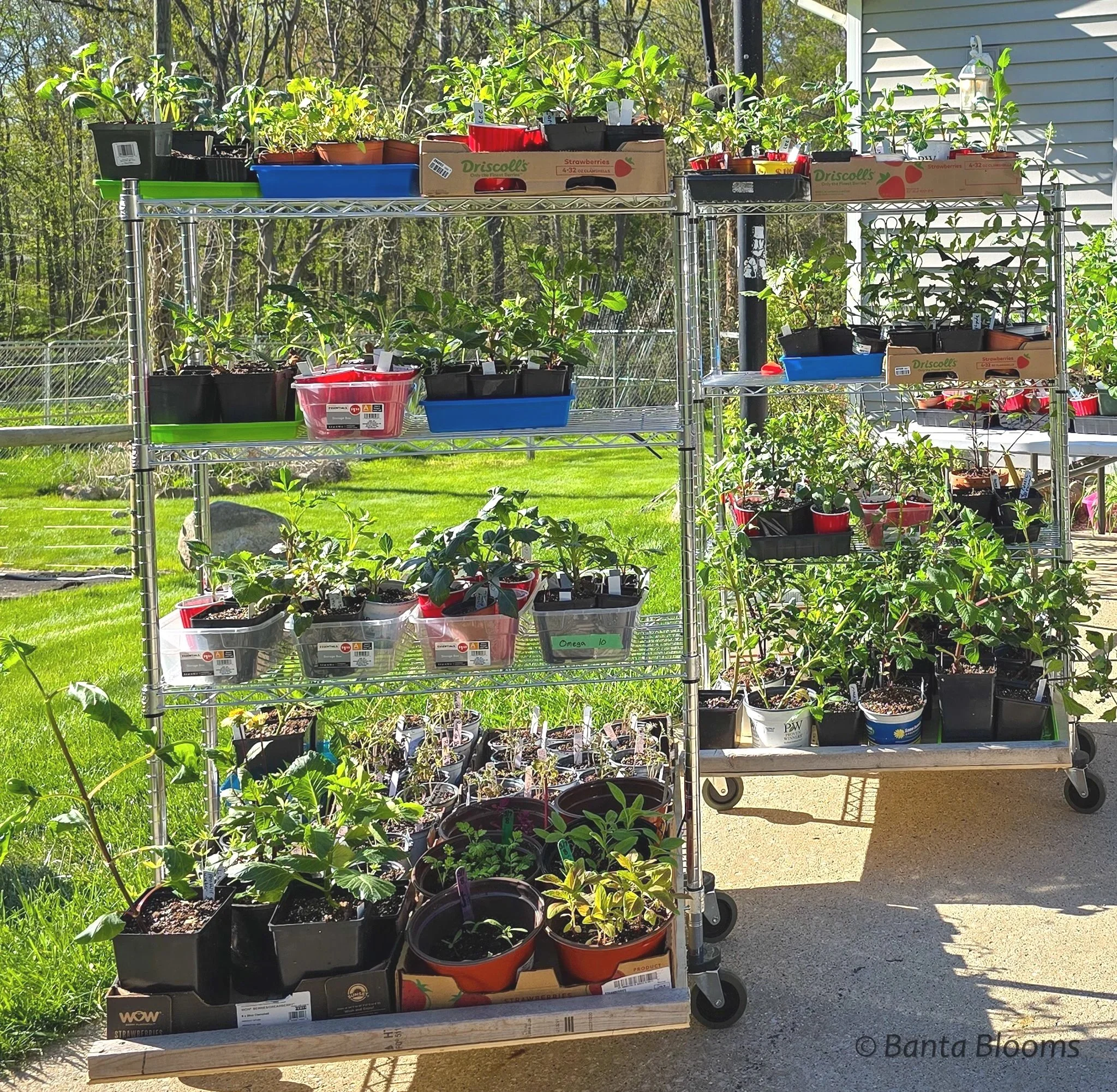
Shelving on wheels used for Harding off in the sprint
Double duty on my shelving, Here’s the same heavy-duty chrome shelving unit in action during hardening off season (late April/early May). I load up the shelves with trays of young dahlia plants then wheel everything outside to harden them off with gradual exposure to sun, wind, and cooler nights. Roll it back into the garage if frost threatens or at night. The wheels, open-grid design, and 350 lbs. per-shelf capacity make this a game-changer—no more lugging individual trays! © Banta Blooms
Final Step: Take Inventory
I log each box in Clade Dahlia inventory: variety, tuber count, and exact location (e.g., Tent A or B, Shelf 1 or 2). This makes spring retrieval effortless, no digging through stacks!
This is how we at Banta Blooms store our dahlias in Zone 6a West Michigan. Hopefully it helps you find the method that works best for you, experiment and adjust to your space!